Why Does My Child’s Shoulder Hurt After Throwing
Many parents begin noticing their child complaining of shoulder soreness during baseball season, especially after practices, pitching, or long tournament weekends. What may start as mild discomfort can gradually become more frequent, leading families to ask: why does my child’s shoulder hurt after throwing?
Throwing places significant stress on the shoulder, especially in growing athletes whose muscles, joints, and coordination are still developing. Repetitive throwing without proper recovery can gradually irritate the structures surrounding the shoulder joint.
Understanding what contributes to throwing-related shoulder pain can help support healthier movement, recovery, and long-term athletic performance.
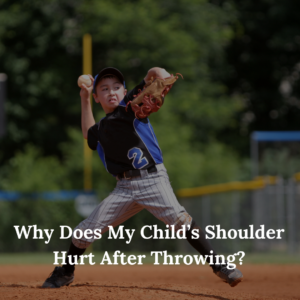
Why Throwing Places Stress on the Shoulder
The throwing motion is one of the fastest and most demanding movements in sports.
During each throw, the shoulder must move through a large range of motion while generating force and maintaining stability at the same time. Over the course of practices and games, this repeated stress can begin affecting muscles, tendons, and joint mechanics.
Young athletes are especially vulnerable during periods of rapid growth when coordination and flexibility are constantly changing.
Overuse During Baseball Season
One of the most common reasons young athletes develop shoulder discomfort is simple overuse.
Pitchers and players who throw frequently may not always get enough recovery between games, practices, camps, and tournaments. As throwing volume increases, irritation can gradually build within the shoulder.
Parents may notice:
- soreness after games
- decreased throwing velocity
- tightness
- pain lifting the arm
- discomfort during warmups
These symptoms often develop slowly rather than from one major injury.
Growth Spurts and Shoulder Pain
Growing bodies handle stress differently than adults.
During growth spurts, bones, muscles, and connective tissues may not develop at the same pace. This can temporarily affect mobility, strength, and coordination around the shoulder.
As a result, throwing mechanics may change slightly, increasing stress on certain areas during repetitive movement.
This is one reason shoulder pain commonly appears during middle school and early high school sports seasons.
Tightness and Limited Mobility
Limited mobility in the shoulders, upper back, or hips can also influence throwing mechanics.
The body works as a chain during athletic movement. If one area becomes tight or restricted, another area often compensates by absorbing additional stress.
Athletes who lack mobility may place more strain directly through the shoulder during throwing motions. Over time, this can contribute to fatigue, irritation, and soreness.
Supporting overall movement quality becomes an important part of injury prevention.
Poor Recovery Between Activity
Recovery is one of the most overlooked parts of youth sports.
Busy summer schedules filled with tournaments and back-to-back practices can make it difficult for the body to recover properly. Fatigue may begin affecting mechanics, posture, and coordination during throwing.
Without enough rest and recovery, repeated stress can continue accumulating throughout the season.
This often increases the likelihood of soreness and overuse-related discomfort.
The Nervous System and Athletic Coordination
The nervous system helps coordinate balance, reaction speed, posture, and muscle activation during sports.
Efficient communication between the brain and body allows athletes to move with better control and stability. When movement patterns become inefficient, certain joints may absorb more stress than intended.
Supporting healthy movement patterns may help athletes throw more efficiently while reducing unnecessary strain on the shoulder.
How Chiropractic Care May Help Young Athletes
Chiropractic care focuses on supporting healthy movement, joint mobility, and nervous system communication.
Many parents explore chiropractic care after their child begins experiencing repeated soreness or limited movement during sports seasons.
For active baseball players and throwing athletes, chiropractic care may help:
- improve mobility
- reduce muscle tension
- support recovery
- encourage healthier movement patterns
Helping the body move efficiently may support both comfort and athletic performance during the season.
Supporting Young Athletes in Traverse City
At Third Coast Chiropractic, we work with many young athletes throughout Traverse City who participate in baseball and other throwing sports.
Long practices, tournaments, and repetitive throwing can place significant demands on growing shoulders during summer sports seasons.
Supporting movement quality, recovery, and mobility may help athletes stay active, confident, and performing at their best throughout the year.